


Whole exome sequencing (WES)
Answers for patients with rare disease or undiagnosed genetic conditions.
- Analyzes ~20,000 protein-coding genes (where most disease-causing variants occur)
- Detects sequence variants and copy number variants (CNVs) in one test
- Reduces time to diagnosis vs. sequential testing1
- Available mitochondrial genome sequencing for multisystem presentations*


Whole exome sequencing (WES) analyzes the protein‑coding and adjacent intronic regions of nearly all clinically relevant genes--where most known disease‑causing variants are found.
WES is an effective diagnostic solution for patients with complex, heterogeneous, or unexplained clinical presentations, particularly when phenotype‑driven answers are needed and prior testing has been inconclusive.[2,3,4]
Guideline-supported indications for WES
WES may be appropriate as an early or first-tier test, supported by American College of Medical Geneticists (ACMG) and American Academy of Pediatrics (AAP) guidance, for patients with[5,6]:
Developmental delay, intellectual disability, or autism spectrum disorder5,6
Epilepsy or complex neurodevelopmental disorders5
Multiple congenital anomalies5
Broad, evolving, or atypical phenotypes
Suspected genetically heterogeneous conditions[2,3]
Negative or inconclusive prior genetic testing4
Ongoing pregnancies with abnormal ultrasound findings7
Non-ongoing fetal cases with a suspected genetic etiology
Whole exome testing options to fit your
patient's clinical needs
Our WES testing options support different clinical scenarios — from undiagnosed rare disease
to time-sensitive and prenatal cases.
Standard Clinical WES
Comprehensive analysis for rare and undiagnosed conditions
Rapid WES
Accelerated turnaround for critically ill patients
Prenatal WES
Exome testing for selected fetal cases
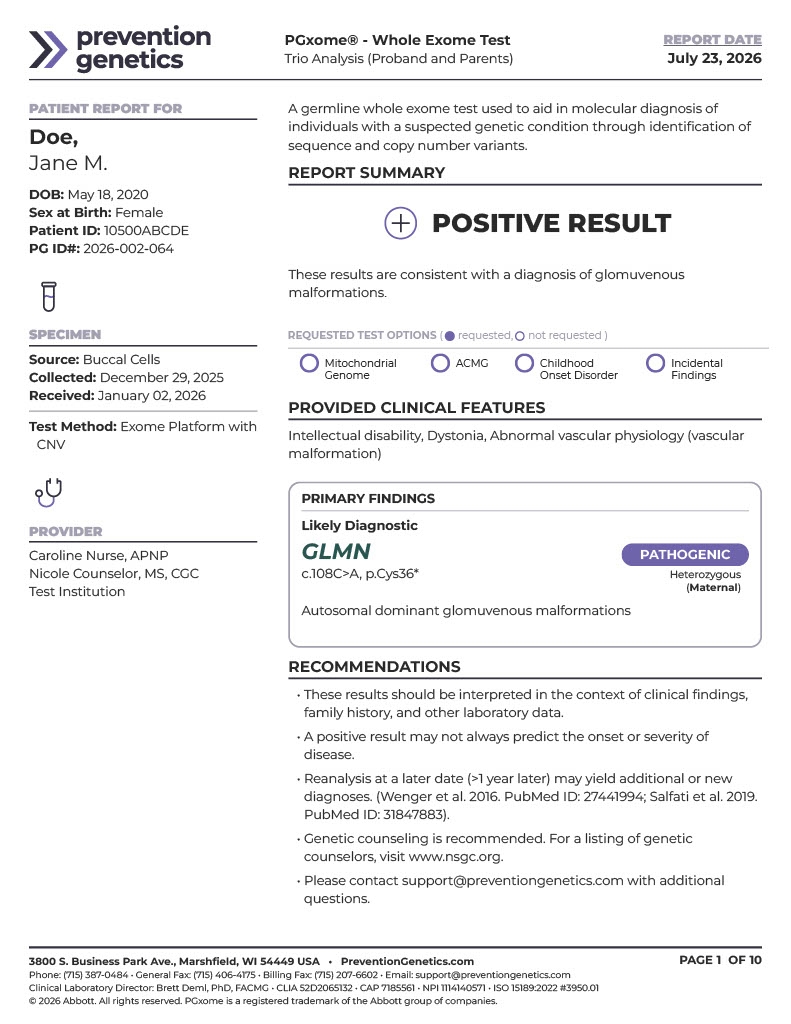
Accurate interpretation is as critical as sequencing itself. Our WES analysis is driven by the patient’s clinical phenotype and follows rigorous variant classification standards.
Results are classified as positive, negative, or indeterminate based on the clinical relevance of identified variants. Variants of uncertain significance (VUS) and certain risk variants are typically reported as indeterminate results.
- Comprehensive analysis of variants classified as pathogenic, likely pathogenic, or variants of uncertain significance (VUS) with relevance to the reported indication(s)
- Phenotype‑driven interpretation to prioritize clinically meaningful findings
- Expert review by experienced laboratory and clinical specialists
- Clearly communicated results in an easy-to-read format

A confirmed genetic diagnosis can:
- Inform targeted treatment or management decisions
- Guide ongoing surveillance or preventive care
- Help avoid additional invasive or unnecessary testing
- Provide information for family members who may also be affected

When available, family-based analysis is strongly recommended.
Research shows that trio testing improves variant interpretation, increases diagnostic yield, and reduces uncertainty by enabling detection of de novo variants and inheritance patterns.10,11

You don’t have to navigate complex cases alone.
- Access to genetic expertise for case‑level consultation and interpretation support
- Ongoing partnership throughout the diagnostic process
- Post-test genetic counseling available through Genome Medical for patients who do not already have access to a genetics provider
Frequently asked questions
Exome or genome—choosing the right approach
Whole exome sequencing (WES) and whole genome sequencing (WGS) both enable analysis of coding regions and select intronic regions with established disease associations. Compared with WES, WGS offers greater sensitivity for detecting small copy-number variants and can uniquely identify structural inversions and repeat expansions in selected genes.12
Our WGS test, PGnome®, may be considered in select cases, such as when prior exome testing is negative or when variants outside protein-coding regions are suspected.
Prefer a targeted approach?
A focused gene panel may be a good starting point when the clinical picture points to a specific condition.
Our predefined panels can be reflexed to whole exome sequencing when broader analysis is needed—helping you expand testing without starting over.